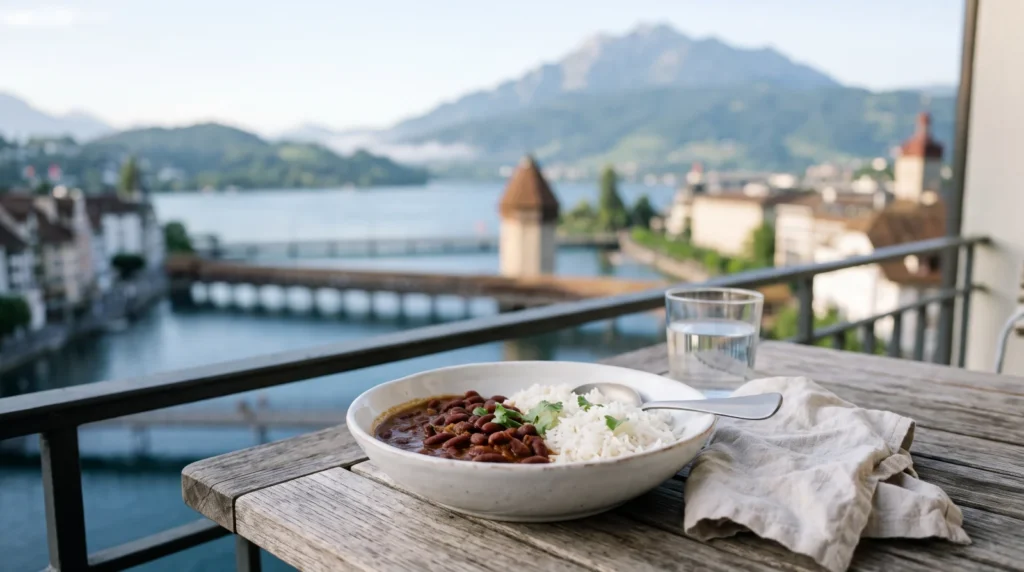
The best food to carry for a Europe trip from India is light, sealed vegetarian food that needs only hot water: freeze-dried meals, instant poha or upma, roasted snacks and small spice packs. Skip anything with milk, ghee, paneer or meat unless you have checked the EU rules, and plan to use your packed food for dinners in small towns, long train days and late hotel check-ins.
Quick answer: pack one hot-water meal per day for the nights when vegetarian food will be hard to find, keep wet curries out of your cabin bag, and carry a way to get hot water, because many European hotel rooms have no kettle.
Why carry food on a Europe trip at all?
Big European cities are easy for vegetarians. The problem is everything in between. A day on the Swiss trains, an evening in a village in the Dolomites, or a 9 pm arrival in a small Austrian town can leave you with bread, chips and a cheese sandwich. Restaurants in many smaller places close their kitchens by 9 or 9.30 pm, and on Sundays some towns barely have a shop open.
There is also the vegetarian trap. In much of Europe “vegetarian” can still mean eggs, soup made with meat stock, or hard cheese made with animal rennet. If you are strict about any of these, a few packed meals take the stress out of the evenings.
What food to carry for a Europe trip from India
Choose food that is light, sealed, does not need a fridge, and survives a suitcase being thrown around. This table compares the usual choices.
| Food | Weight and space | How you eat it in Europe | Points to watch |
|---|---|---|---|
| Freeze-dried Indian meals | Very light, the water is removed | Add hot water, cover, wait about 7 minutes | Needs hot water; check if a dish contains milk or ghee |
| Retort pouch curries | Heavy, mostly water | Warm the pouch in hot water or eat at room temperature | Wet food is often treated as a liquid or gel at cabin security |
| Instant poha, upma, oats | Light | Hot water or a kettle in the room | Good for breakfast before an early train |
| Roasted chana, makhana, khakhra | Light but bulky | Eat straight from the pack | Keep sealed; crushes easily if packed loose |
| Spice mix sachets, pickle in a sealed pack | Small | Add to plain pasta, rice or salads | Oily pickles leak; double bag them |
Can I carry Indian food to Europe? The customs basics
The rules differ by country, so read the official site of the country you land in and the EU page on personal imports before you pack. A few points apply across most of the EU:
- The EU restricts meat and milk products in personal luggage when you arrive from outside the EU. Anything with milk, ghee, butter, cream, khoya or paneer can fall under these rules.
- Plant-based foods in sealed, labelled commercial packs are the simplest to carry. Keep them in their original packaging with the ingredient list visible.
- If you are not sure whether something is allowed, declare it. Officers can take food away, and not declaring it can lead to a fine.
- Switzerland, the UK and Norway set their own rules, so check each one separately if your route crosses them.
Cabin bag or check-in bag?
Put wet food in your check-in bag. Curries in pouches, pickles and sauces are often treated as liquids or gels at security, and anything over 100 ml can be taken away from your cabin bag. Dry food such as freeze-dried meals, snacks and instant poha is solid and is easier in the cabin, which helps on long layovers. For more on flights, see the guide on carrying ready-to-eat food on a flight.
How to get hot water in a European hotel
This is the step most Indian travellers miss. Hotels in India usually have a kettle in the room. In France, Italy, Spain, Switzerland and much of Central Europe, many rooms do not.
- Email the hotel before you arrive and ask if the room has a kettle.
- If not, ask reception or the breakfast room for a flask of hot water. Most will help.
- Or pack a small foldable travel kettle. India and mainland Europe both use 230 volts, so an Indian kettle works with a plug adapter. Most countries use Type C or F sockets; Switzerland uses Type J and Italy also uses Type L.
- Carry a deep bowl or a reusable tub with a lid, a spoon and a small towel to wrap the bowl while the food sits.
Water that is only warm will not rehydrate food properly. If the food is still crunchy after 7 minutes, add a little more very hot water, stir and wait 2 more minutes. The guide to rehydrating freeze-dried food on freezedriedfood.in goes deeper into what goes wrong.
How much to pack for a 7 to 14 day trip
- Dinners: one ready meal for every day you will be outside a big city, plus 2 spare for late arrivals.
- Breakfasts: 3 to 4 packs of poha or upma for early trains, when hotel breakfast has not opened.
- Snacks: about 1 to 2 kg of dry snacks for the whole group for train days and long museum days.
- Extras: tea bags, a small spice mix, and salt and pepper sachets to lift plain pasta or salad.
For dinners, a filling rice dish works best because it is a full meal in one bowl. Freeze-dried rajma chawal from Spice Up Foods is 100% vegetarian, has a 6 months shelf life and needs only hot water, 7 minutes. For early starts, freeze-dried poha is a light breakfast you can make in the room before the first train. Check the ingredient list of any meal against the customs rules of the country you are entering.
Vegetarian words that help when eating out
Packed food is a backup, not the whole plan. Learn a few words and you can eat out with more confidence:
- German: vegetarisch, and “ohne Fleisch, ohne Ei” for no meat, no egg.
- French: végétarien, and ask “sans viande, sans œuf”.
- Italian and Spanish: vegetariano. Ask if a soup or risotto is made with meat stock.
Margherita pizza, falafel, pasta with tomato sauce and Indian restaurants in big cities are reliable choices. Supermarket chains in most countries also sell ready salads, bread, fruit and yoghurt, which go well with a packed curry.
Read next: Can you carry ready-to-eat food on a flight? and Indian food to take to Germany as a student
Questions people ask
Can I carry Indian food to Europe from India?
Yes, many sealed, shop-bought vegetarian foods such as snacks, spice mixes and plant-based ready meals can go in your luggage. The EU restricts meat and milk products in personal luggage from outside the EU, so check the official EU personal imports page before you pack anything with milk, ghee, butter, cream or paneer, and declare food at customs if you are unsure.
Is it easy to find vegetarian food in Europe?
In large cities such as London, Paris, Amsterdam and Berlin it is easy to find vegetarian and Indian food. In small towns, mountain villages and parts of Eastern Europe the choice is thin, and dishes sold as vegetarian may contain eggs, meat stock or cheese made with animal rennet.
How do I make ready-to-eat food in a European hotel room?
Many hotel rooms in mainland Europe have no kettle, so ask reception or the breakfast room for hot water or pack a small travel kettle with a Type C plug adapter. Freeze-dried meals need only hot water and about 7 minutes in a covered bowl or tub.
How much food should I carry for a 10 day Europe trip?
For a 10 day trip, 6 to 8 ready meals for dinners outside big cities, a few breakfast packs like poha or upma, and 1 to 2 kg of dry snacks is usually enough. Plan to eat out in big cities and use the packed food on travel days and in small towns.
For a Europe trip where dinners are hard to plan, Spice Up Foods makes freeze-dried Indian meals that are light to pack and ready with hot water. See Spice Up Foods meals