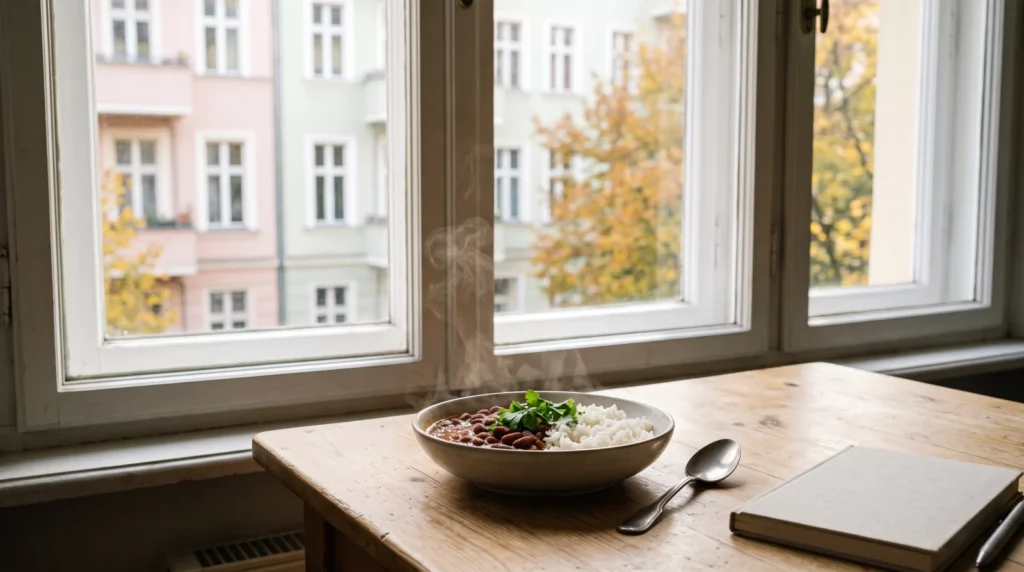
You can find ready to eat Indian food in Germany at Indian grocery stores in big cities and online, but it costs more and the vegetarian choice is small, so most Indian students carry 2 to 3 weeks of sealed, factory packed meals from home. Pack light, shelf stable vegetarian food such as freeze-dried dal chawal, rajma chawal and poha, plus ground spices, and leave milk products like ghee and paneer at home.
The first few weeks are the hardest time to eat well. You are finding a room, opening a bank account, registering your address and learning a new city, and cooking a full Indian meal is often the last thing on your mind. This guide explains what to pack, what to skip, and how to eat well as a vegetarian once you arrive.
Why the first month is the tricky part
Most Indian students land in Germany with a short list of things to do and very little time. Many start in temporary rooms or shared flats with a basic kitchen and no spices. German supermarkets have good bread, cheese, pasta and vegetables, but the taste of home is harder to find, and Indian grocery shops are mostly in the bigger cities.
A small stock of familiar food helps you get through those first weeks without living on bread and instant snacks. It also saves money while you are still working out prices.
Check the customs rules before you pack
Germany follows European Union rules on food brought in by travellers. Meat and milk products from countries outside the EU are generally not allowed in your luggage. Items made with milk, such as ghee or paneer, can fall under this rule, so think twice before packing them.
Rules can change, so always read the official German customs website (zoll.de) before you fly. If you are not sure about an item, declare it at the airport and let the officer decide. That is always safer than guessing.
Indian food worth packing for Germany
Pick things that are light, sealed, easy to cook and hard to find in a small German town:
- Whole and ground spices: turmeric, cumin, coriander powder, garam masala, hing and chilli powder. A small set lasts for months.
- Ready to eat vegetarian meals: dal, rajma, chole or khichdi that only need hot water. These are a lifesaver for the first nights.
- Pickles and chutney powders: sealed well and wrapped in a plastic bag in case of leaks.
- Snacks for the journey: khakhra, roasted chana or dry namkeen for the flight and the first train rides.
- Tea and masala chai mix: a familiar cup on a cold morning helps more than you would expect.
Keep everything in its original sealed packing with the ingredients printed on it. That makes it easier to answer any questions at customs.
What to leave at home
- Fresh fruit, vegetables and seeds, which have their own strict rules.
- Homemade sweets and anything made with milk, ghee or khoya.
- Large bags of rice, atta or dal. These are heavy, and you can buy them in Germany.
- Anything loose or unlabelled that a customs officer cannot easily identify.
Cooking in a German student kitchen
Most student halls and shared flats in Germany have a shared kitchen with a stove, a small fridge space per person and an electric kettle. Fridge space is often tight, so food that keeps without cooling is useful.
A few habits make life easier:
- Cook a big pot of dal or rajma on the weekend and eat it over two or three days.
- Keep a few hot water meals for late lab days and exam weeks.
- Buy rice, lentils and flour from Asian or Indian grocery shops, which are easy to find in cities like Berlin, Munich, Frankfurt and Hamburg.
- Use the university canteen, called the Mensa, for cheap lunches. Most of them offer a vegetarian dish every day.
Eating out as an Indian vegetarian in Germany
Germany is easier for vegetarians than many people think. Look for the words vegetarisch (vegetarian) and vegan on menus. Bakeries sell pretzels and cheese rolls, and falafel and pizza shops are found almost everywhere.
If you do not eat egg, ask about it, because many baked goods and pasta dishes contain egg. A simple question, “Ist da Ei drin?”, means “Is there egg in this?”
Can you buy ready to eat Indian food in Germany?
Yes. Indian and Asian grocery stores in Berlin, Munich, Frankfurt, Hamburg, Cologne and Stuttgart sell retort pouch curries, instant mixes and frozen parathas, and several online shops deliver across Germany. In smaller university towns the nearest Indian store can be an hour away, and prices are noticeably higher than in India.
- Retort pouch curries: easy to find in big cities, but heavy and usually without rice.
- Frozen Indian food: needs a freezer, which shared student kitchens rarely have space for.
- Freeze-dried meals: rare in German shops, so most students bring them from India.
For the first weeks, a few complete meals from home save money and time. Freeze-dried dal tadka chawal and freeze-dried rajma chawal are 100% vegetarian, have no preservatives and a 6 months shelf life, and need only hot water, 7 minutes, so a kettle in a dorm room is enough.
How much to bring
You do not need a suitcase full of food. A good rule is enough spices for three to four months and enough ready meals for your first two weeks. After that, you will know where to shop and what things cost. Check your airline’s baggage allowance and the liquid limits for cabin bags before you pack.
Read next: what Indian students pack for Canada, or how long ready to eat food really lasts.
Questions people ask
Can I take Indian food to Germany as a student?
Yes, many packed and sealed vegetarian foods are commonly carried. Meat and milk products from outside the EU are generally not allowed. Check the German customs website (zoll.de) before you fly, and declare anything you are unsure about.
Can I bring ghee or paneer to Germany?
Ghee and paneer are milk products, and milk products from outside the EU are generally restricted for travellers. It is safest to leave them at home and buy them from Indian shops in Germany.
Is it easy to find Indian groceries in Germany?
In big cities such as Berlin, Munich, Frankfurt and Hamburg, Indian and Asian grocery shops are easy to find. In small university towns, the choice is smaller, so packing spices helps.
What is the best food to carry for the first week in Germany?
Light, sealed, vegetarian meals that need only hot water work best, along with a small set of spices and some dry snacks. They help you eat well while you settle in.
Can you buy ready to eat Indian food in Germany?
Yes, Indian grocery stores in big German cities and online shops sell retort pouch curries, instant mixes and frozen Indian food. Choice is smaller and prices are higher than in India, so many students also bring a few weeks of sealed meals from home.
For the busy first weeks in Germany, Spice Up Foods makes 100% vegetarian, freeze-dried Indian meals with a 6 months shelf life (Hot water, 7 minutes). See Spice Up Foods meals